
Our craft
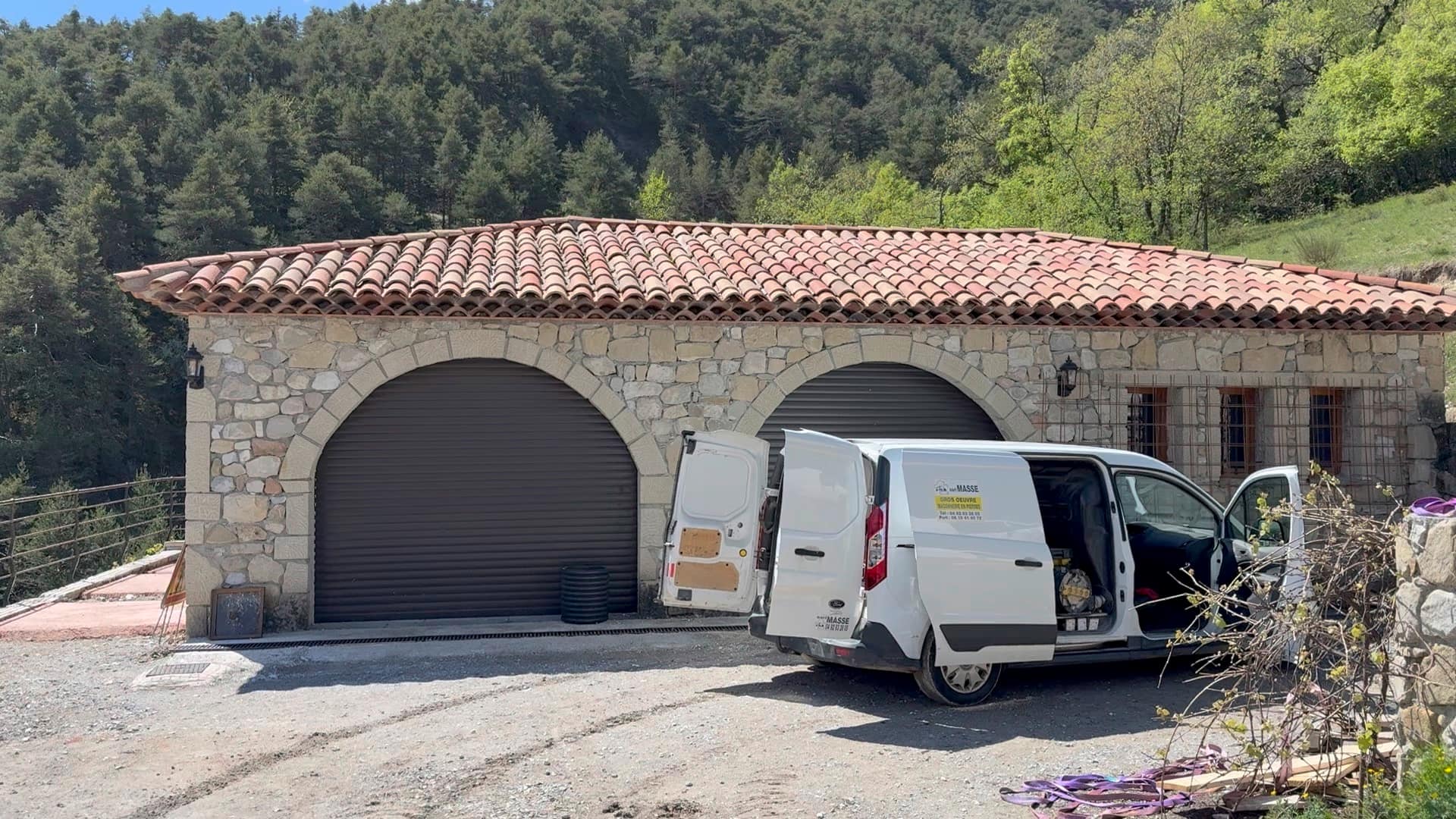
A stone house, course after course.
Scroll: the house goes up in front of you, in the real order of the site. Each stage carries the name we give it on the ground, and the reason it cannot be skipped.
The site, in six movements
From the first cut of the ground to the last tile.
This is not an artist's impression: it is the build logic we follow on every stone house, in this order, since the 1970s.
01
Earthworks
We cut into the ground, bring the site to level and prepare access. On a slope in the French Alps this is often the longest stage — and the one that decides everything after it.
The right level is found before the first stone, never after.
- 01
Earthworks
The right level is found before the first stone, never after.
- 02
Foundations
A shallow foundation shows up ten years later, in the cracks.
- 03
Raising the stone walls
A well-bedded stone never moves again. A drowned one moves anyway.
- 04
Openings and lintels
Above an opening, the load looks for a way around. We help it.
- 05
Timber frame
A roof never makes up for a badly built wall.
- 06
Roof and finishes
Success is when the neighbour cannot tell which building we worked on.
Cross-section
What is really inside a stone wall.
An old wall is not a pile of stones: it is a three-layer assembly, built to carry, to breathe and to last. Step through the layers.
Outer skin
Select a layer
Our craft in detail
Four things a machine will not do.
Cutting
We recut stone with a pitching tool and a lump hammer so it finds its place, rather than forcing the wall to accept it as it comes. A well-cut stone carries; a roughly bedded one keeps working.
The exposed-stone joint
The mortar stays set back, the stone keeps the leading role and the wall carries on shedding its moisture. That is what separates real restoration from a façade veneer.
Tying
At corners and openings, we tie the masonry so it works as one piece. Invisible once finished, decisive when the ground moves or the earth shakes.
The lintel
Timber, stone or a masonry arch: above an opening, the load has to be sent out to the sides. Choosing the right lintel decides what the façade will look like in fifty years.
Materials
We work with what the valley gives.
Local stone, timber and lime: they are what give the houses here their colour. Bringing a material in from elsewhere adds a false note you never quite fix.
- Local stone
- Limestone and sandstone from the valley, salvaged on site when the building provides enough. Stone that is already old sits better than new stone.
- Lime
- It lets the wall breathe, it moves a little with it, and it ages well. On an old building it is almost always the right choice.
- Timber
- Frames, lintels, overhangs: solid timber, generously sized, that accepts working with the house without complaining.
- The mortar
- A mix of lime and sand, made up on site. It is what sets the colour: we test on the wall before signing anything off.
Frequently asked
What people ask us most.
Who is SARL MASSE?
SARL MASSE is a family-run structural masonry business specialising in stone, based in the Alpes-de-Haute-Provence in south-eastern France. Founded in the 1970s by Jean-Denis Masse and his brother, it has been run since 22 January 1996 by his two sons, Olivier and Franck Masse.
Where does SARL MASSE work?
SARL MASSE works mainly in the Annot area and the upper Verdon, in the Alpes-de-Haute-Provence, and a little in the Alpes-Maritimes. The communes listed on this site are where we are at home, not a limit: for a village that is not listed, call us and we will tell you honestly whether it works.
What kind of projects do you take on?
We restore old stone buildings, build stone and retaining walls, carry out earthworks and structural masonry, build roofs and timber frames, and construct new houses.
What are your lead times?
Our order book is full up to three years ahead for larger projects. We prefer to say so at the first phone call rather than promise a date we could not keep.
Do you work stone the traditional way?
Yes. We lay stone by hand, course by course, with exposed-stone joints and mortars mixed on site. A successful restoration is one where nobody can tell any work was done.
Do you also build new houses?
Yes. We build new houses to the same standard as our restoration work: foundations, elevations, frame, roof and finishes, often with local stone facing.
Do you take on small jobs?
It depends on the season and the distance. A retaining wall or a façade repair can often fit between two larger projects. The simplest thing is to call us and talk it through.
What materials do you use?
We favour local stone, lime and solid timber. The mortar is a mix of lime and sand, whose colour gives the houses here their tone. Mixes are made on site and tested on the wall before approval.
If you read this far, we probably have something to talk about.
Describe your building or your plot. We will tell you honestly what can be done, how we would go about it, and when.
Or call us directly 04 92 83 26 05